
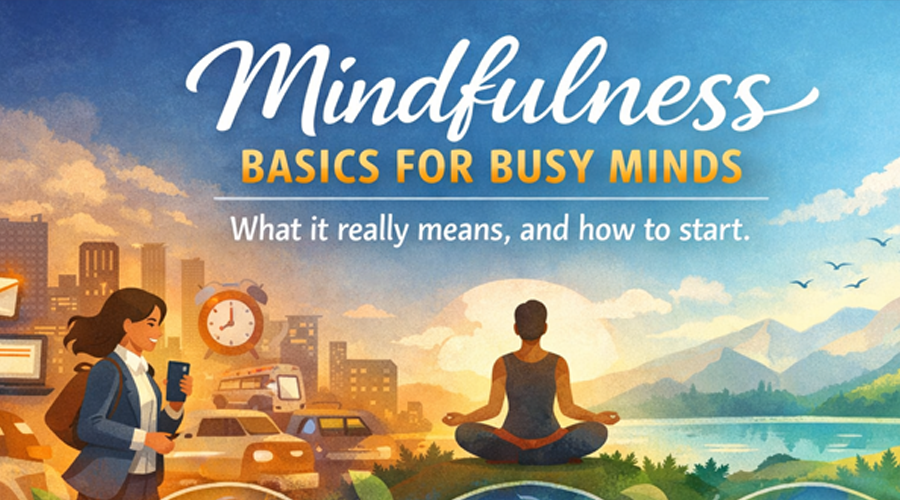
Mindfulness Basics for Busy Minds: What it really means, and how to start.
Understanding Mindfulness in the Modern World
In today’s fast-paced, hyper-connected lifestyle, mindfulness is no longer a luxury; it is a practical skill for mental clarity, emotional balance, and sustainable productivity. We recognize that busy minds are not empty minds. They are overloaded minds, constantly processing information, decisions, notifications, and responsibilities. Mindfulness, at its core, is the disciplined practice of intentional awareness—remaining fully present with thoughts, emotions, bodily sensations, and surroundings without judgment.
Unlike passive relaxation techniques, mindfulness is an active mental state. It sharpens attention, stabilizes emotions, and strengthens cognitive control. For individuals juggling professional demands, personal obligations, and digital noise, mindfulness offers a structured method to regain focus and inner stability without disengaging from daily life.
What Mindfulness Really Means Beyond the Buzzword
Mindfulness is often misunderstood as silence, meditation retreats, or complete mental stillness. In reality, mindfulness is the ability to observe mental activity without being controlled by it. Thoughts do not disappear; instead, their influence weakens.
We define mindfulness as the practice of conscious attention anchored in the present moment, supported by acceptance and clarity. It involves:
- Awareness of thoughts without attachment
- Recognition of emotional patterns
- Grounding attention in the body and breath
- Responding deliberately instead of reacting impulsively
This approach builds mental resilience, allowing busy individuals to navigate pressure, deadlines, and uncertainty with composure.
Why Busy Minds Need Mindfulness More Than Ever
High-performing individuals often operate on autopilot, shifting rapidly from one task to another. While this may feel efficient, it leads to mental fatigue, reduced creativity, emotional reactivity, and burnout. Mindfulness interrupts this cycle by introducing intentional pauses.
Consistent mindfulness practice enhances:
- Focus and concentration
- Stress regulation
- Decision-making accuracy
- Emotional intelligence
- Sleep quality
- Overall psychological well-being
For busy minds, mindfulness is not about slowing life down. It is about experiencing life with greater precision and control.
The Science-Backed Foundations of Mindfulness
Neuroscientific research demonstrates that mindfulness reshapes brain function through neuroplasticity. Regular practice strengthens the prefrontal cortex, responsible for attention and reasoning, while reducing overactivity in the amygdala, the brain’s stress-response center.
This neurological shift results in:
- Reduced anxiety and emotional overwhelm
- Improved memory and learning capacity
- Greater impulse control
- Heightened self-awareness
Mindfulness trains the mind to remain alert yet calm, a crucial balance for modern professionals and entrepreneurs.
Core Principles of Mindfulness Practice
To integrate mindfulness effectively, we adhere to several foundational principles:
Present-Moment Awareness
Attention is placed on what is happening now, not on past regrets or future projections.
Non-Judgmental Observation
Experiences are acknowledged without labeling them as good or bad.
Acceptance Without Resistance
Thoughts and emotions are allowed to arise and pass naturally.
Intentional Focus
Attention is repeatedly guided back to a chosen anchor, such as the breath or physical sensations.
These principles form the backbone of all mindfulness techniques, regardless of complexity.
How to Start Mindfulness with a Busy Schedule
Mindfulness does not require hours of free time. It requires consistency and precision. We recommend starting with small, structured practices that fit seamlessly into daily routines.
Mindful Breathing (2–5 Minutes)
Focus attention on the natural rhythm of breathing. Observe inhalation and exhalation without altering them. When the mind wanders, gently return to the breath.
Body Awareness Check-Ins
Pause during the day to notice posture, muscle tension, and physical sensations. This builds a direct connection between mind and body.
Single-Tasking Discipline
Engage fully with one task at a time. Eliminate background distractions and maintain attention on the current action.
Mindful Transitions
Use routine moments—walking, waiting, or commuting—as opportunities to observe surroundings and internal states.
These practices create mental clarity without disrupting productivity.
Mindfulness at Work: Enhancing Performance and Focus
In professional environments, mindfulness directly influences efficiency, leadership presence, and communication quality. Mindful professionals demonstrate:
- Clearer thinking under pressure
- Improved listening skills
- Reduced workplace stress
- Higher adaptability to change
By cultivating awareness before responding, mindfulness minimizes errors and strengthens strategic thinking. Teams that practice mindfulness experience greater collaboration and emotional intelligence.
Overcoming Common Barriers to Mindfulness
Busy individuals often face predictable challenges when starting mindfulness. We address them directly:
“I Don’t Have Time”
Mindfulness integrates into existing routines. Even one mindful breath resets attention.
“My Mind Is Too Busy”
A busy mind is not a problem; it is the training ground. Mindfulness observes activity rather than suppressing it.
“I’m Not Doing It Right”
There is no perfect experience. Awareness itself is success.
Consistency dissolves resistance and builds confidence over time.
Long-Term Benefits of a Mindful Lifestyle
Sustained mindfulness practice leads to profound internal shifts. Over time, individuals experience:
- Greater emotional stability
- Deeper self-understanding
- Improved relationships
- Enhanced creativity
- Sustained mental energy
Mindfulness transforms how challenges are perceived and managed. Life becomes less reactive and more intentional.
Integrating Mindfulness Into Daily Life
True mindfulness extends beyond formal practice. It influences how we speak, listen, eat, work, and rest. We encourage mindful awareness during:
- Conversations
- Meals
- Physical movement
- Decision-making
- Rest and recovery
This integration turns mindfulness into a way of being, not a separate activity.
Final Perspective on Mindfulness for Busy Minds
Mindfulness is a skillset for conscious living. For busy minds, it offers a structured method to regain focus, calm, and clarity without withdrawing from responsibilities. It trains attention, strengthens emotional resilience, and supports sustainable success. By starting small and practicing consistently, mindfulness becomes a powerful internal resource, enabling individuals to thrive in complexity rather than being overwhelmed by it.


Add Comment