
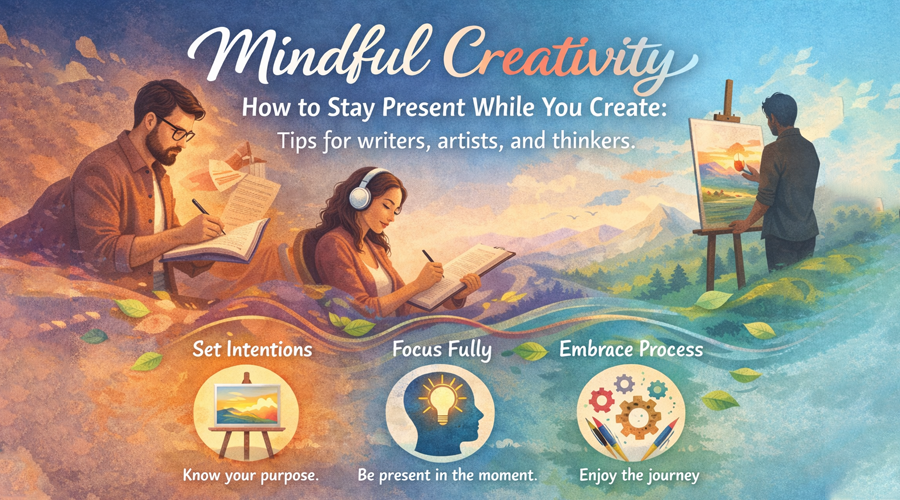
Mindful Creativity: How to Stay Present While You Create: Tips for writers, artists, and thinkers.
Cultivating Presence as the Foundation of Creative Excellence
We begin creative work not with tools or techniques, but with attention. In an era defined by constant notifications, fragmented focus, and accelerated timelines, the ability to remain present while creating has become a decisive advantage. Mindful creativity is the disciplined practice of anchoring awareness in the present moment while engaging fully with the creative process. It allows writers, artists, and thinkers to produce work that is not only technically refined but also deeply resonant, coherent, and original.
Presence transforms creativity from a hurried output-driven activity into a deliberate, immersive experience. When we are present, ideas unfold with clarity, decisions feel intuitive, and the creative process becomes sustainable rather than draining. This article explores how to stay present while creating, offering precise, practical strategies designed to elevate both the quality of creative output and the experience of making it.
Understanding Mindful Creativity as a Skill, Not a Mood
Mindful creativity is not a fleeting state that appears only when conditions are perfect. It is a trainable skill developed through consistent practice and intentional habits. Presence does not eliminate distraction; it refines our ability to recognize distraction without being ruled by it.
Creative professionals who cultivate mindfulness experience:
- Greater cognitive clarity
- Reduced creative anxiety
- Improved problem-solving depth
- Stronger emotional connection to their work
By approaching mindfulness as a practical discipline rather than a philosophical ideal, we create a reliable framework for sustained creative performance.
Preparing the Mind Before the Work Begins
Designing a Ritual of Entry
Presence begins before the first word is written or the first line is drawn. We establish mindful creativity by creating a ritual of entry—a short, repeatable sequence that signals the transition from distraction to focused creation.
Effective entry rituals include:
- Two minutes of steady breathing
- Clearing the workspace of non-essential objects
- Writing a single sentence that defines the intention of the session
These rituals train the mind to associate specific cues with deep focus, reducing resistance and accelerating immersion.
Clarifying Intent Without Overthinking Outcomes
Mindful creators work with clear intent, not rigid expectations. Intent directs attention; expectations fracture it. Before beginning, we define:
- What we are working on
- Why this session matters
- What “enough” looks like for today
This clarity prevents mental drift and minimizes the internal pressure that often disrupts presence.
Staying Present During the Creative Process
Single-Tasking as a Creative Discipline
Presence collapses when attention is divided. Mindful creativity requires single-tasking, the intentional commitment to one creative action at a time. Multitasking fragments thought and weakens the coherence of creative output.
We maintain presence by:
- Closing unrelated tabs and applications
- Silencing notifications
- Working in defined time blocks with clear start and end points
Single-tasking allows ideas to develop fully, without interruption or dilution.
Breath Awareness While Creating
Breath is the most immediate anchor to the present moment. We do not need to stop creating to practice breath awareness; we integrate it seamlessly into the process.
By periodically noticing:
- The rhythm of the breath
- Physical tension in the body
- The pace of our thinking
we recalibrate attention without breaking creative flow. This subtle awareness prevents mental fatigue and sustains focus over longer sessions.
Working With Creative Resistance Mindfully
Observing Resistance Without Engaging It
Resistance is not an obstacle; it is information. Mindful creativity teaches us to observe resistance without internal conflict. When hesitation, self-doubt, or boredom arises, we acknowledge it neutrally and return to the task.
This approach:
- Prevents emotional escalation
- Preserves creative momentum
- Reduces the habit of avoidance
Presence dissolves resistance not by force, but by attention.
Letting Go of Self-Judgment in Real Time
Judgment pulls the mind into the past or future. Presence lives only in the now. During creation, we suspend evaluation and allow imperfect ideas to exist without correction.
Mindful creators separate:
- Creation mode, where ideas flow freely
- Refinement mode, where analysis and editing occur
This separation protects presence and accelerates productivity.
Enhancing Creative Depth Through Sensory Awareness
Engaging the Senses to Anchor Attention
Sensory awareness grounds creativity in the present moment. We deepen focus by consciously noticing:
- The texture of the keyboard or brush
- Ambient sounds in the environment
- Subtle shifts in posture or energy
These sensory cues anchor attention in the body, preventing mental drift and enhancing immersion.
Using Environment as a Supportive Element
A mindful creative environment minimizes friction and supports sustained presence. We design spaces that are:
- Visually uncluttered
- Comfortably lit
- Consistent in setup
Consistency reduces decision fatigue and allows attention to settle quickly into creative work.
Mindful Breaks That Preserve Creative Flow
Stopping Before Exhaustion
Presence erodes under fatigue. Mindful creativity respects natural limits by integrating intentional breaks. We pause not when energy is depleted, but while focus is still intact.
Effective mindful breaks include:
- Brief movement or stretching
- Silent rest without screens
- Short walks with conscious attention
These pauses reset attention and prevent burnout without disrupting creative continuity.
Reflecting Without Rumination
Reflection strengthens presence when it is precise and contained. At the end of a session, we note:
- What worked
- What felt distracted
- What to continue next time
This reflection is factual, not emotional. It informs future sessions without pulling attention into unnecessary analysis.
Long-Term Benefits of Mindful Creativity
Consistency Over Intensity
Mindful creativity prioritizes consistency over intensity. Presence allows us to return to creative work day after day without depletion. Over time, this approach produces:
- Higher-quality output
- Stronger creative identity
- Greater satisfaction with the process
Creativity becomes sustainable rather than sporadic.
Alignment Between Thought, Emotion, and Action
When present, our thoughts, emotions, and actions align. This alignment gives creative work a sense of coherence that audiences intuitively recognize. Mindful creativity produces work that feels intentional, grounded, and authentic.
Integrating Mindful Creativity Into Daily Practice
Mindful creativity is not reserved for special projects or ideal conditions. We integrate it into daily practice by:
- Beginning each session with awareness
- Returning attention gently when it wanders
- Ending work with clarity rather than exhaustion
Over time, presence becomes the default state from which creativity emerges naturally and reliably.
Conclusion: Presence as the Creative Advantage
Mindful creativity is not a trend or technique; it is a competitive advantage in a distracted world. By staying present while we create, we elevate not only the quality of our work but also the integrity of the creative process itself. Presence sharpens perception, deepens insight, and transforms creativity into a disciplined, fulfilling practice.
When we create mindfully, every session becomes purposeful, every idea gains clarity, and creative work evolves from effort into craft.

Add Comment